

Septic, Subdivisions & Water
Central District Health’s (CDH) Environmental Health Division oversees a number of programs relating to the health and the environment within Ada, Boise, Elmore and Valley counties.
Environmental Health Specialists at Central District Health (CDH) permit septic systems, review land development applications and verify location of shallow injection wells to ensure reliable and safe water resources for the community.
Note: The state of Idaho is responsible for monitoring and dealing with environmental concerns and hazards.
- Air quality
- Water quality
- Harmful Algal Blooms
- Waste management
- Environmental health factors and hazards
- Report an Environmental Concern
Septic System Search
The links below provide an interface to all subdivision and septic system records in CDH databases. We strive to maintain complete and accurate records, but cannot guarantee that all historic records in our databases are error-free. Please consider this in your use of records obtained here.
Note: The records compiled date back to 1971, but not all properties will appear in the database. Some older records specifically from Ada County could not be configured to fit into the system. Therefore, a search for some records of permits issued prior to the year 2000 may result in a “No Match” finding because images of those documents do not exist in the new database. When searching for older permits we recommend searching by the legal description of the property – for example: lot, block, and subdivision – as physical addresses were not always provided or entered.
Impact Of Statewide Drought Emergency On Septic Permitting
On April 13, 2026, Governor Brad Little and the Idaho Department of Water Resources (IDWR) issued an Emergency Drought Declaration for all 44 counties in Idaho. This action follows record-low snowpack levels across the state.
In addition to water usage restrictions, these drought conditions directly impact the approval and monitoring of new septic systems. Homeowners and developers should be aware of the following technical requirements and potential delays regarding site evaluations and groundwater monitoring:
Groundwater Monitoring and “Low Water Year” Restrictions
Per the Idaho DEQ Technical Guidance Manual (TGM), specifically Section 2.4.5, the state imposes strict scrutiny on groundwater records during drought periods.
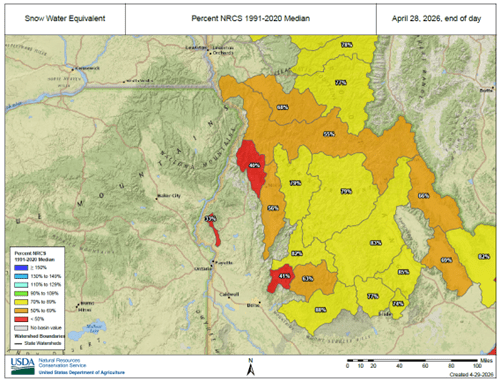
- Definition of Low Water Year: Snow-water equivalents of less than 75% of normal are considered an extremely low water year.
- Permit Validity: Because groundwater levels are currently below normal, monitoring performed this year may need to be repeated in a future year. Regulators must ensure that septic drainfields maintain the required separation from the water table during “normal” years to prevent contamination.
Mandatory Monitoring Periods
If your permit requires groundwater or runoff monitoring, please adhere to the following windows established in TGM Section 2.4.2.3:
- Seasonal Runoff Monitoring: February 15 through June 30.
- Irrigation Water Monitoring: April 15 through October 31.
Resources for Property Owners
To determine if your property is currently categorized under these “Low Water Year” restrictions, please consult the following resources:
- Snowpack Update Report: Review current snow-water equivalents at the USDA NRCS Report Page.
- Interactive Map Tool: Accessible via the link above, this tool provides real-time data on whether your specific basin meets the 75% threshold.
- Official Guidance: Refer to the full DEQ Technical Guidance Manual for all onsite sewage disposal standards.
While we understand that re-monitoring may delay construction timelines, these measures are essential to ensure your septic system functions safely and protects Idaho’s groundwater for the long term.
Onsite Septic & Sewer Systems
Installers Guidance
- Installer Bond Form – DEQ
- Septic Installer Education and Exam Information
- DEQ – Septic Installer Exam
Installer Continuing Education
In order to be in compliance with CDH’s Environmental Health septic standards, you must complete the following training video, in its entirety, followed by completing the acknowledgement below affirming that you will adhere to the policies and procedures in compliance with DAPA 58.01.03 and the Technical Guidance Manual provided by the Idaho Department of Environmental Quality (DEQ). The CDH Environmental Health team will retain record of this acknowledgement.
Sewage Program Fees – Jul 2026
- Permit – New – $1070
- Permit – New – No test hole/Site Visit – $535
- Permit – Expansion (no test hole) – $535
- Permit – Expansion (no test hole) – $535
- Permit – Repair (no test hole) – $535
- Permit – Repair (with test hole) – $1070
- Permit – Central/LSAS – New or Repair – $2250
- Accessory Use Review – $141
- Accessory Use Review – Field Visit – $535
- Permit – Tank Only – $535
- Permit – Vault Privy – $535
- Speculative site evaluation – $535
- Permit – additional test holes – $535
Resources
- Homeowner’s Guide to Septic Systems
- Standard Distances for a Septic Tank or Standard Drainfield
- List of permitted septic tank pumpers
- List of permitted septic system installers
- List of Idaho certified service providers
- Approved Materials and Gravel Pits
- Groundwater Monitoring Log
- Onsite Sewage Disposal Rules
- Aerobic Treatment & Drainfields Brochure
- Septic Systems & Drainfields Brochure
- DEQ – Septic and Septage Guidance
- DEQ – Technical Guidance Manual
- EPA – Septic Smart
Subdivisions & Land Development
CDH reviews land development proposals for the release of sanitary restrictions.
To apply for licenses and permits, click here
Land Development Fees and Resources
- Standards for Land Development Brochure
- Ground Water Monitoring Log
- Nutrition Pathogen Mass Balance Level 1 Spreadsheet
- District Nutrient Pathogen Policy
- DEQ – Septic and Septage guidance
- DEQ – Nutrient Pathogen Evaluations
Subdivision Fees – Jul 2026
- Plat served by Municipal Sewer Services – $348
- Plat served by Septic System (per lot fee) – $387
- Served by Large Soil Absorption System (per lot fee) – $387
Shallow Injection Wells
In Idaho, construction features like dry wells, seepage beds, infiltration trenches, infiltration galleries, and French drains are collectively known as shallow injection wells. Storm water runoff from paved surfaces is the most common type of fluid disposed of using shallow injection wells, but these features are used for disposal of a variety of fluids, including industrial process water, heat pump return flow, etc.
The Idaho Department of Water Resources (IDWR) manages shallow injection wells in Idaho through the Underground Injection Well Program (UIC) under a primacy agreement with the United States Environmental Protection Agency. CDH helps monitor these features.
To submit an application, click here
Information
Shallow Injection Well Fees
Mortgage Surveys
A mortgage survey is often requested by a lender to determine the location of a well or septic system to check water and sewage systems prior to a property sale.
To submit an application, click here
Mortgage Survey Fees: – July 2026
- MS – Well Only – $178 (plus lab fee of $20)
- MS – Septic Only – $178
- MS – Well and Septic – $178 (plus lab fee of $20)
- MS – Lab Fee – $20
- MS – Revisit – $178 (plus lab fee of $20)
In Idaho, private well owners are responsible for ensuring their water is safe to drink.
Private water sources can be required to be tested under other regulations or requirements if the water is being used for small daycares, small food processors, bottled water plants, foster/care homes, and house sales if required by lender or buyer.
CDH does not provide water testing kits. Use one of the following resources to test your private water supply:
Well Disinfection Information
Disinfection is the process of killing or deactivating microorganisms to make water safe for drinking. Disinfection can also eliminate nuisance bacteria that can cause unpleasant tastes and odors.
Private Well Sampling Application & Fees
CDH provides drinking water quality testing and mortgage survey inspections of private wells and septic systems.
Drinking Water Quality Fees – July 2026
- Water Sample Collection – $145
- Coliform Test – $20
- Fluoride Test – $21
- Nitrate Test – $21
- Nitrite Test – $21
- Arsenic Test – $23
Testing for Contaminants
While your water may appear safe, harmful levels of contaminants occur at such low concentrations that they often cannot be tasted, seen, or smelled. This means regular testing and maintenance are necessary to protect the health of your family. You should test your well water once a year for bacteria and nitrates.
- Nitrate Fact Sheet
- IDHW – Groundwater Quality Near Me Map – Use this map to help determine what contaminants for which to test.
If undesirable levels of contaminants show up in your water, contact The Department of Health and Welfare’s Environmental Health program at radon@dhw.idaho.gov or 1-800-445-8647 to determine the best method to fix the problem and if you have questions about your well water testing results.
- IDHW – Drinking Water – Resources on common contaminants and how to take a water sample for testing.
- IDHW – Arsenic in Your Well Water
- IDHW – Bacteria in Your Well Water
- IDHW – Fluoride in Your Well Water
- IDHW – Nitrate in Your Well Water
- IDHW – Uranium in Your Well Water
Solid Waste Guidance and Resources
The Idaho Department of Environmental Quality (DEQ) oversees solid waste management at the state level:
- DEQ – Solid Waste – Idaho Department of Environmental Quality
- DEQ – Guide to Recycling and Waste Management in Idaho
If you have questions about waste disposal in your area, please contact your county waste management:
- Ada County Solid Waste Management
- Boise County Solid Waste Department
- Elmore County | Bennett Road Transfer Station/landfill
- Valley County Transfer Station / Recycling Center